Kallol Choudhury
For more than three decades, poet and writer Kallol Choudhury has worked in the space where Bengali, Assamese, and English meet. His name appears in journals and anthologies that track modern Indian writing, yet his path has stayed close to the page rather than the stage. Translation remains his core craft. Alongside that work, he writes poems in Bengali and English and publishes short fiction. The record shows a steady output rather than a sudden rise, shaped by books, edited volumes, and public readings that link the Northeast with a wider Indian audience.
Early steps and a small book with a long reach
Choudhury’s public journey in translation began with a slim volume, Two Footprints In The Train of Time. The book came out in 1989 and was launched in Silchar during the Nikhil Bharat Banga Sahitya Sammelan. The event drew attention because the then Chief Minister of Assam, Prafulla Mahanta, presided over the release. The book did not claim to be large in scope. Its role was modest but clear. It marked a start and set a pattern. From that point, his pen did not rest. He continued to translate while also writing original poems in Bengali and English.
Building a bridge between poets of Bengal and Assam
Over the years, Choudhury translated poems by major Bengali poets such as Jay Goswami and Nirendranath Chakravarti. He also brought into English the work of leading Assamese poets, including Hirendranath Chakrabarty, Samir Tanti, Anupama Basumatary, Nilim Kumar, and Prem Narayan Nath. These translations did not stay confined to private circles. They appeared in journals such as Indian Literature, The Little Magazine, Chandrabhaga edited by the late Jayanta Mahapatra, and India In Verse edited by Antara Devsen. The placements show how his work moved across editorial desks and reached readers who follow contemporary poetry.
A role in public debates on history and memory
In 2005, as a member of the North East Writers Forum, Choudhury took part in a panel in New Delhi organised by Katha. The topic was “History, Memoirs and Anti-memoirs.” By then, he had already published a book in 1997 on Netaji, the Azad Hind Fauj, and Captain Doctor Manmatha Choudhury. The subject carried personal weight. Manmatha Choudhury was his uncle, who died in Moneya near Manipur during Netaji’s march toward Delhi. At the same time, Choudhury had begun research work on Sonbeel, known as the second largest beel in Asia, in Assam. These two strands, history and place, helped him speak with ease on the panel. Those present in Delhi noted the clarity of his talk.
Links with Oxford and a major translation milestone
The following year brought two markers. On 23 February 2006, Oxford University Press in New Delhi invited him to the launch of Where the Sun Rises when Shadows Fall: The Northeast, a book to which he contributed. In the same year, Sahitya Akademi published his Bengali translation of Jayanta Mahapatra’s award-winning poetry book Relationship. The original had won the Sahitya Akademi Award in 1981. The translation placed Choudhury in a line of writers who carry major Indian poetry across languages without losing tone or intent.
A return to his own poetry
Also in 2006, his debut Bengali poetry collection, Tumi Jao Megheder Kachhe, reached readers. The timing matters. It shows that even as his name became known through translation, he kept space for his own voice. The pattern continued in later years with more poetry titles, including Karunanjali and Mehagani Andhakar, both published in 2021.
Short stories from Assam and a wider audience
A key year for his work in prose came in 2010. He translated and edited Bengali Short Stories of Assam: Glimpses, published by Saptarshi Prakashan, Kolkata. The book did more than add to a shelf. A London publisher bought a large number of copies for sale abroad. In India, the Raja Ram Mohan Roy Library Foundation, Kolkata, purchased many copies for distribution across the country. Reviews appeared in Indian Literature and other dailies. Jayanta Mahapatra summed up the collection by noting that the stories were personal and contemporary and that they dealt with relationships and the presence of militancy in interior regions.
A public launch and continued presence in anthologies
The book was launched on 4 December 2010 at the Asian Literary Festival in Guwahati. Sir Mark Tully, the former BBC correspondent known for chronicling modern India, shared the stage with Professor Temsula Ao of NEHU and Dr Srutimala Duara of Handique Girls’ College. The following year, The Oxford Anthology of Writings from Northeast India included Choudhury’s short story “Haflong Hills” in its fiction volume. In the poetry and essays volume, his translations of poets from Assam and Tripura appeared. British author Gillian Wright reviewed these volumes in Outlook and referred to his short story. The same story later found a place in LAPBAH: Stories from the North-East, published by Penguin Random House.
A Dhaka edition and a later Indian release
In 2015, his first Bengali short story collection, Shanbiler Chele, was published from Dhaka. The book includes historical stories linked to Shanbil, along with other pieces. The Indian edition came later, in 2024, through Aajkaal Prakashan, Kolkata. The gap between editions points to a steady, cross-border interest in the themes he handles, especially stories rooted in place and memory.
Collaboration and critical notes
Among the three books released in 2021, one stands apart for its joint authorship. The Walls of Flesh, co-written with Dr Jernail Singh Anand, drew a comment from Ashok K. Bhargava, President of Writers International Network in Vancouver. In the preface, he wrote that Choudhury maps the geographies of emotion and the self through a poetic look at human conditions that move between belief and metaphor. The remark reflects how critics often frame his work, not as spectacle, but as close study of inner and outer worlds.
Writing, activism, and Sonbeel
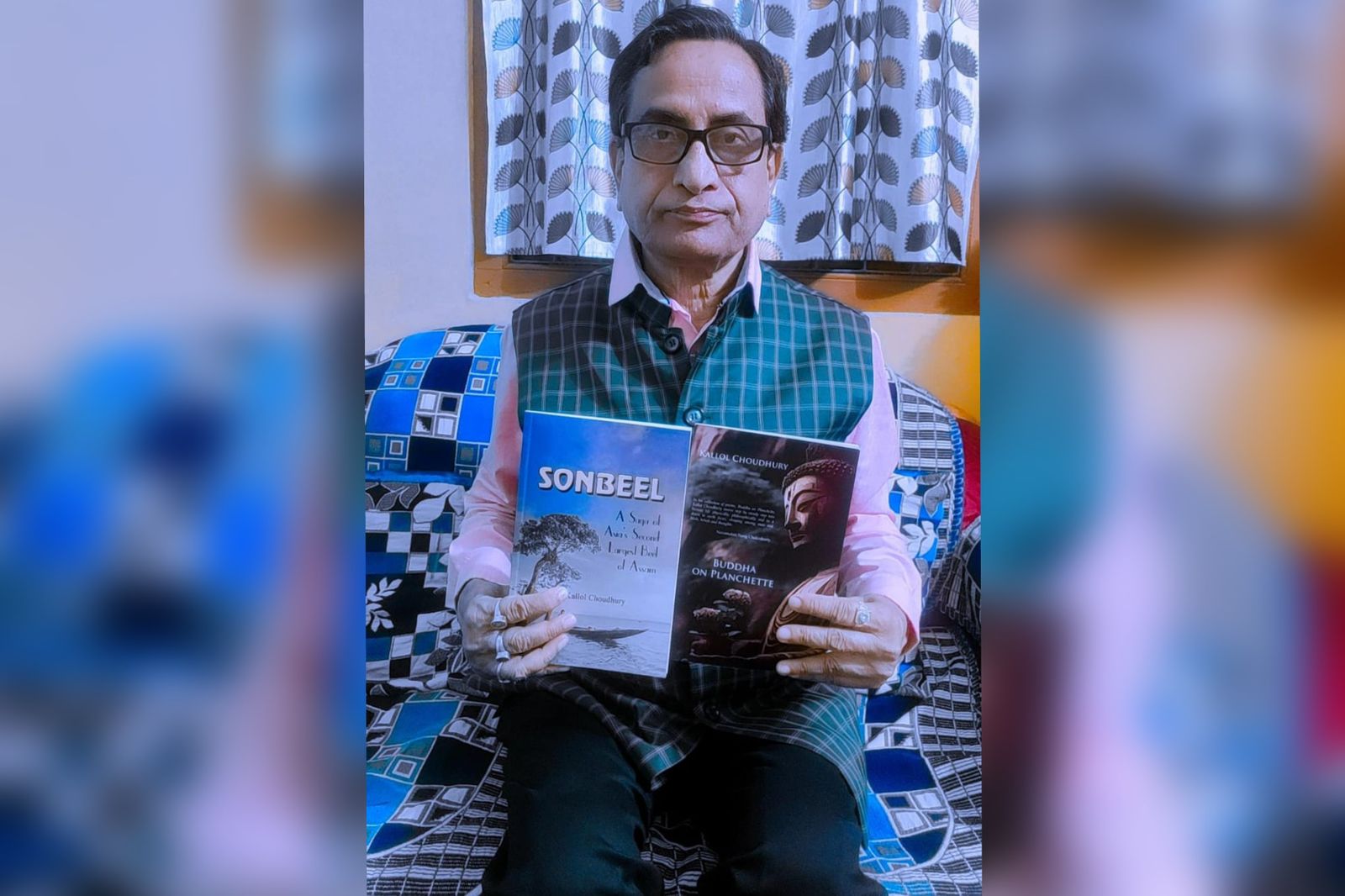
Choudhury also works as a social activist, with a long focus on Sonbeel in Assam. He has argued for years that the area holds promise as an eco-tourism site. His research-based book, SONBEEL: A Saga of Asia’s Second Largest Beel of Assam, sets out different aspects of the wetland. Historian Professor J. B. Bhattacharjee spoke in praise of the study. The book adds a non-fiction layer to a career better known for poetry, fiction, and translation.
Recent poetry and the ongoing record
His poetry collection Buddha on Planchette has been described by readers as a set of poems that aim to move the inner life rather than court attention. That description fits the wider arc of his work. From early translations to edited story collections and research on Sonbeel, Kallol Choudhury’s career shows a consistent method. He works with texts, places, and histories, and he keeps them in clear view for readers who may not share the same language or region.
A steady presence in Indian letters
In an age that often rewards noise, his path looks different. It is built on patient translation, careful editing, and books that find their audience over time. The record across journals, anthologies, and presses in India and abroad suggests that Kallol Choudhury has become a quiet link between literary cultures of the East, and between the past they record and the present they face.
About the Author