Anish Kanjilal
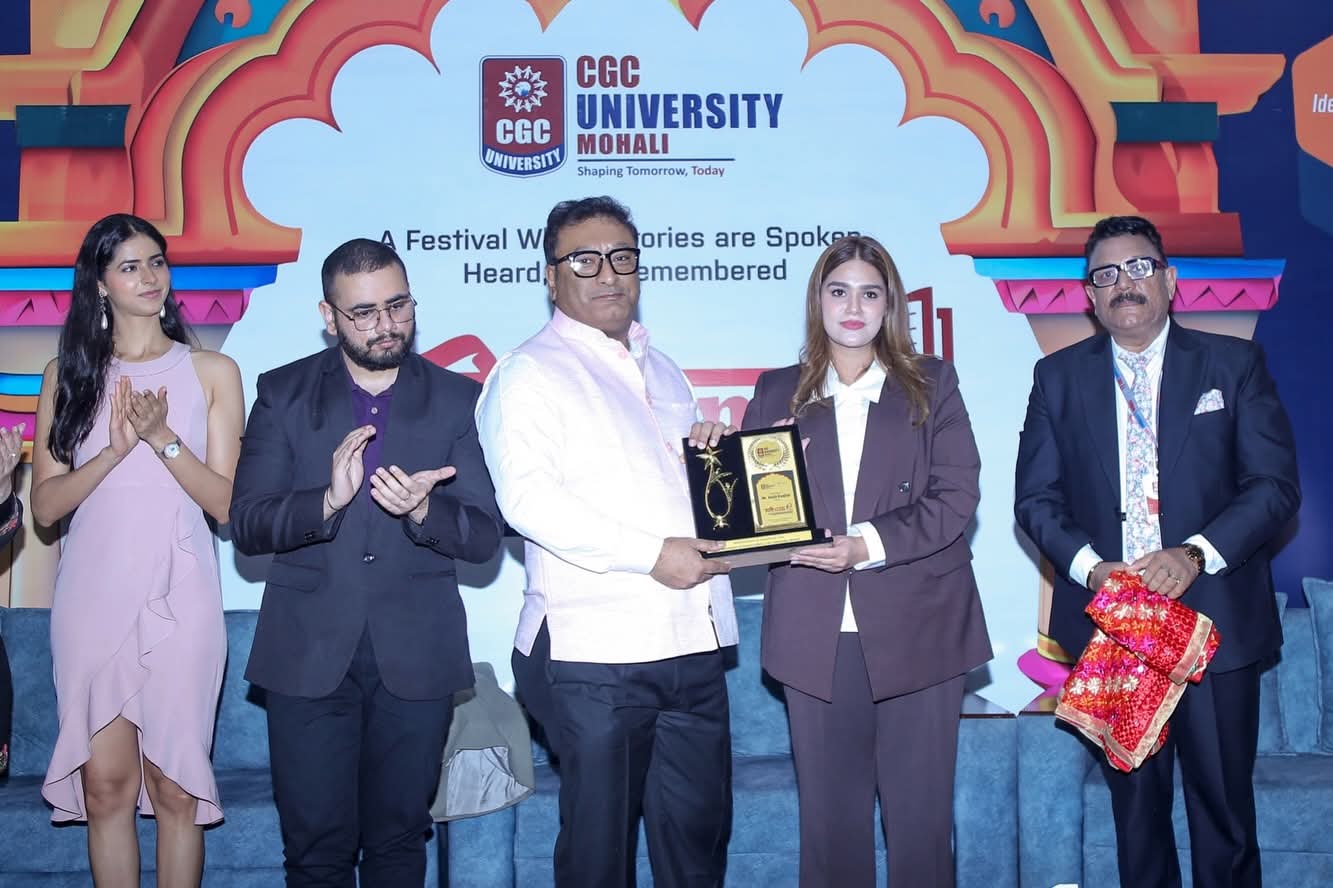
“It is said that books don’t just tell stories; they create stories within us.” With these powerful words, CGC University, Mohali set the tone for Sahityam 2026, hailed as one of India’s largest literature festivals — a vibrant celebration of ideas, intellect, and the enduring power of the written word.
As thousands of books filled the campus with their silent yet resonant presence, each story seemed to carry its own heartbeat. Day 1 of Sahityam 2026 unfolded as an inspiring confluence of celebrated voices, distinguished leaders, and curious young minds eager to engage in meaningful dialogue.
A Gathering of Celebrated Voices
The opening day featured renowned personalities including renowned author and speaker Anish Kanjilal, actress Pankhuri Gidwani, Journalist Navjot Randhawa, and distinguished Olympian Ashish Kumar Chaudhary. Their discussions traversed literature, leadership, language, and the evolving mindset of new generations.
Anish Kanjilal, reflecting on his panel discussion, remarked that the session seamlessly moved “from literature to leadership,” reinforcing the idea that books are not confined to shelves — they shape ideologies, movements, and nations.
Literature in the Age of Gen Z
One of the most engaging moments came during a light-hearted yet thought-provoking exchange about language evolution. Addressing the predominantly Gen Z audience, Kanjilal humorously contrasted traditional expressions like “alright” and “okay” with today’s minimalist “K.”
Yet, beneath the humor lay a deeper message. Language, he emphasized, is in constant evolution. “Change is the biggest constant,” he noted, describing language as a process of progression — not mere creation, but continuous transformation.
Drawing from philosophy and science alike, he referenced Swami Vivekananda’s concept of “progression” and even touched upon ideas akin to “time bending” long before they became common in modern scientific discourse. The suggestion was clear: literature, philosophy, and science are not isolated disciplines — they intersect and influence one another profoundly.
The Power of Words in History
Kanjilal reminded the audience of how language has shaped history. He invoked Winston Churchill, who “sent the English language to the battlefield.” Through stirring rhetoric during World War II, Churchill’s speeches revived hope in a nation on the brink of despair.
Language, therefore, is not passive — it is an instrument of resilience and revolution.
At the same time, Kanjilal urged students to maintain the richness and dignity of language even as it evolves. A strong vocabulary, they emphasized, builds confidence. Words like “bewitching” or phrases like “boil down to” carry nuance and strength that elevate expression and thought.
Literature’s Influence on Leadership and Society
The discussions went beyond language to examine how literature shapes leaders and ideologies.
Kanjilal’s reference to Leo Tolstoy illustrated how storytelling carries moral and philosophical weight. Tolstoy’s works, including moral allegories about greed and excess, deeply influenced Mahatma Gandhi, particularly in shaping his philosophy of non-violence and Satyagraha. Gandhi also drew inspiration from thinkers like John Ruskin — further evidence that books quietly mold world-changing leaders , voiced Kanjilal.
The conversation then moved to political philosophy. Karl Marx’s transition from abstract philosophy to political economy following the “theft of wood” debates in 1842 eventually led to the publication of The Communist Manifesto and Das Kapital. Whether one supports or critiques communism, its global impact is undeniable. It reshaped geopolitics, influenced revolutions, and contributed to a balance of power in the modern world , said Kanjilal.
“Imagine a world without communism,” Kanjilal reflected — not as advocacy, but as an acknowledgment of literature’s far-reaching consequences.
From Tolstoy to Marx, from Gandhi to global superpowers, the underlying message remained consistent: ideas written in books have the power to transform societies.
The Teacher’s Challenge in a Changing World
The festival also acknowledged contemporary challenges. Teaching and public speaking, which are becoming increasingly demanding in an era of shortened attention spans and digital distractions. Yet the solution circles back to reading — cultivating depth, patience, and intellectual curiosity.
Confidence, Kanjilal stressed, is born from knowledge. A well-read mind can command silence in a crowd.
He quoted “Read”: The Most Powerful Word in the English dictionary
The day concluded with a resounding call to action. Quoting a Scottish proverb — “Many a mickle makes a muckle” — Kanjilal underscored that small intellectual efforts accumulate into transformative change. Literature intertwines with politics, economics, science, and leadership in ways both subtle and profound.
In an age of rapid evolution — linguistic, technological, and ideological — Sahityam 2026 stands as a reminder that books remain our most reliable companions. They challenge us, shape us, and quietly prepare the leaders of tomorrow.
At CGC University, Mohali, Sahityam is not merely a festival. It is a reaffirmation that stories do not end on the last page — they begin within us.
About the Author